See kinetic energy through pictures and visual examples. Our visual guide shows how moving objects carry energy in real-world scenarios.
Kinetic energy is the energy of motion, and you can spot it in anything that moves: a rolling ball, a sprinting dog, wind, ocean waves, or a car on the highway. The pictures and diagrams on this page show what kinetic energy looks like in real life.
Key facts:
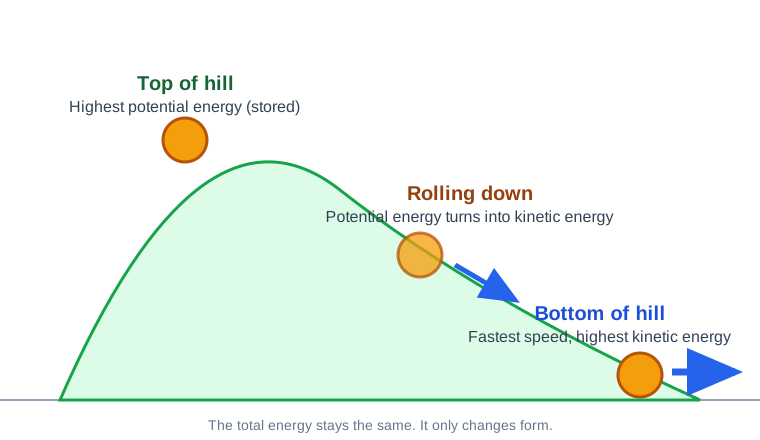
Kinetic energy is invisible. You cannot see it like you see a tree or a car. But you can see what it does. When you look at a moving object, you are seeing kinetic energy in action.
Think of kinetic energy like the wind. You cannot see the wind itself. But you can see leaves blowing and flags flapping. The effects tell you the wind is there. Kinetic energy works the same way. You see the motion and know the energy is there.
In pictures and diagrams, we show kinetic energy with clues. Arrows show direction. Speed lines show how fast something moves. Labels tell you the mass and velocity. Together, these help you picture the invisible energy.
Look at these scenes and find the kinetic energy in each one.
A Rolling Ball. Picture a ball rolling across a field. The ball is moving, so it has kinetic energy. The faster it rolls, the more energy it has. If it hits a toy, the toy moves. The kinetic energy transferred from the ball to the toy.
A Swinging Pendulum. Think of a playground swing. When you pull back and let go, the swing moves. At the bottom of the swing, it moves fastest. That is where kinetic energy is highest. At the top of the swing, it pauses. That is where kinetic energy is lowest.
A Falling Leaf. Imagine a leaf falling from a tree. It drifts and spins as it falls. It has kinetic energy the whole way down. When it lands, the energy goes into the ground as a tiny bit of heat.
A Spinning Top. Picture a top spinning on a table. It has rotational kinetic energy. As it slows down, the energy turns into heat from friction. Soon the top stops and the energy is gone (changed into heat).
A Bouncing Ball. Imagine dropping a ball. Just before it hits the ground, it has lots of kinetic energy. It hits, squishes, and bounces back. The energy changes form many times in one bounce.
A roller coaster is one of the best ways to see kinetic energy in pictures. Let us walk through a ride and picture the energy at each point.
Picture 1: The Climb. The car is pulled up the first hill. It moves slowly. Kinetic energy is low. Potential energy is building as the car gets higher.
Picture 2: The Top. The car reaches the top and pauses. Kinetic energy is almost zero. Potential energy is at its highest. The car is as high as it will go.
Picture 3: The Drop. The car goes over the top and down. Potential energy turns into kinetic energy. The car speeds up. Halfway down, it has half PE and half KE.
Picture 4: The Bottom. The car is at the lowest point. It moves fastest here. Kinetic energy is at its maximum. All the potential energy from the top has turned into kinetic energy.
Picture 5: The Next Hill. The car goes up again. Kinetic energy turns back into potential energy. The car slows down. But it does not go as high as before because friction removed some energy.
Now let us add some numbers to the pictures. This helps you understand exactly how much energy is involved.
Car Moving at Different Speeds
Imagine a 1,000 kg car. At 10 m/s, it has 50,000 J of KE. At 20 m/s, it has 200,000 J. The car is only twice as fast, but it has four times the energy. A picture showing both speeds would need to show this big difference.
Ball Thrown Upward
Picture a ball thrown straight up. At the start, all energy is kinetic. Halfway up, half is KE and half is PE. At the top, all is PE. On the way down, PE turns back into KE. A good diagram would show this change at each point.
Pendulum Swing
A pendulum is great for pictures. Draw it at three positions: high left, bottom, and high right. Label the KE and PE at each spot. At the bottom, KE is max and PE is min. At the high points, KE is min and PE is max.
Rolling Object
A ball rolling down a ramp has both types of kinetic energy. It has translational KE from moving forward. It has rotational KE from spinning. A picture with two arrows can show both types.
Here are some useful diagrams you can draw or find.
The Pendulum Diagram. Draw a pendulum at three positions. Label the energy at each point. At the top left: high PE, low KE. At the bottom: low PE, high KE. At the top right: high PE, low KE. This shows energy changing back and forth.
The Roller Coaster Diagram. Draw a roller coaster track with hills. Label PE at the high points and KE at the low points. Add arrows to show where energy is converting.
The Ball Drop Diagram. Draw a ball at five heights as it falls. Label the energy at each height. At the top: all PE. At 3/4 height: 75% PE, 25% KE. Halfway: 50% each. At 1/4: 25% PE, 75% KE. At the bottom: all KE.
The Spring Diagram. Draw a spring at three positions: compressed, at rest, and stretched. Label the elastic PE at the compressed and stretched positions. Label the KE at the rest position (where it moves fastest).
Think about these real-world scenes and the kinetic energy in each.
A Soccer Game. The player runs (KE of the body). The ball flies (KE of the ball). The goal net moves when the ball hits it (KE transfer). The whistle vibrates (sound is KE too).
A Kitchen. Water boils (KE of vibrating atoms). A blender spins (rotational KE). A knife cuts (translational KE). Food falls (gravitational PE to KE).
A Construction Site. A hammer swings (KE). A drill spins (rotational KE). A crane lifts (KE to PE). A dump truck moves (huge KE from high mass).
A Playground. Kids swing (pendulum motion). Slides convert PE to KE. Seesaws trade PE and KE. Merry-go-rounds have rotational KE.
Discussion Questions
Classroom Activity: Draw the Energy
Give students a scene (a roller coaster, a pendulum, a falling ball). Have them draw the scene and label where KE and PE are highest and lowest. Add arrows to show energy conversion.
Common Misconceptions
Some students think pictures of energy show the energy itself. They show the effects of energy, not the energy. Energy is not visible.
Some students think a diagram with one arrow shows all the energy. A rolling ball has both translational and rotational KE. Both should be shown.
Last updated: September 14, 2026
1. In a picture of a pendulum, where is kinetic energy highest?
2. What does a picture of a moving car show?
3. In a roller coaster picture, where is KE the highest?
4. A picture of a stretched rubber band shows what?
5. What does an arrow in a kinetic energy diagram show?
What does kinetic energy look like?
Kinetic energy itself cannot be seen, but you can see its effects. A moving car, a flying ball, and spinning wheels all show kinetic energy in action.
How can pictures help explain kinetic energy?
Pictures show real examples of motion. You can see the object moving and imagine the energy it carries. This makes the idea easier to understand.
What is the best picture to show kinetic energy?
A picture of a roller coaster at the bottom of a drop shows maximum kinetic energy. The cars are moving fast and the riders are experiencing the energy.
Can you draw a diagram of kinetic energy?
Yes. A simple diagram shows an object with an arrow showing its direction and speed. Add labels for mass and velocity to show how KE is calculated.
How do diagrams help with potential and kinetic energy?
Diagrams of pendulums and roller coasters show where energy is stored (PE) and where it is moving (KE). This helps you see the energy change.