Understand potential and kinetic energy and how they transform into each other. Explore conservation of mechanical energy through real-world examples like pendulums, roller coasters, and bouncing balls.
Potential energy is stored energy. Kinetic energy is the energy of motion. Most things around you constantly trade one for the other. A roller coaster stores potential energy on the climb, then converts it to kinetic energy on the drop. A swinging pendulum swaps between the two on every pass.
Key facts:
Ever wound up a rubber band and felt it tug against your fingers? That’s potential energy. It’s energy that has the potential to do something, stored and waiting to be released.
Any object above the ground has gravitational PE. Higher and heavier means more stored energy. That’s why a book on a high shelf can hurt if it falls on your toe.
PE = mgh: mass (kg) x gravity (9.8 m/s²) x height (m)
A 5 kg book on a 2 m shelf has PE = 5 × 9.8 × 2 = 98 J. Knock it off, and all 98 J become kinetic energy by the time it hits the floor.
Springs, rubber bands, trampolines, and bows store elastic PE when stretched or compressed. Formula: PE_elastic = ½kx² (k = spring constant, x = displacement). Ever bounced on a trampoline? When you push it down, you’re storing elastic PE. That’s what launches you back up.
Found in food, batteries, and gasoline. Your body converts chemical PE from food into kinetic energy every time you move. That sandwich you ate for lunch? That’s potential energy waiting to become your next sprint.
Here’s the key idea: potential energy and kinetic energy constantly convert back and forth. This happens everywhere, all the time. You’re watching it happen right now, probably without realizing it.
The Ball Drop: Hold a ball at shoulder height (all PE). Let go. As it falls, PE converts to KE. Halfway down, it’s half PE and half KE. Right before the ground, nearly all PE has become KE. On the bounce up, the reverse happens. You’ve seen this thousands of times without thinking about it.
The Archer’s Bow: Pull back the string to store elastic PE. Release, and that energy converts to KE in the arrow. Same with a rubber band you snap across the room.
E_total = PE + KE = constant
In a system with no friction or air resistance, total mechanical energy is conserved. Energy never disappears. It only changes form. Think of it like a bank account. You’re just moving money between two accounts (PE and KE). The total never changes.
Friction converts mechanical energy into thermal energy (heat). Roll a ball across carpet. It starts with KE, but friction turns that KE into heat. The ball stops. The energy didn’t vanish. It warmed the carpet by a tiny amount. Feel the bottom of your laptop after gaming for a while? That’s friction turning kinetic energy into heat.
Ever been on a roller coaster? If you have, you already understand potential and kinetic energy.
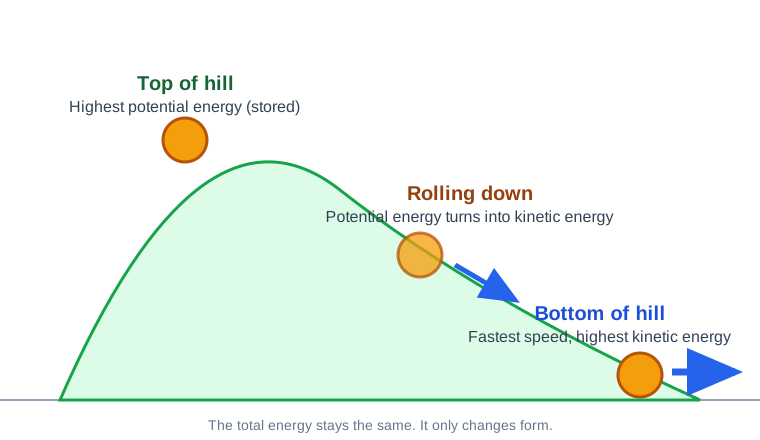
Imagine you are at the top of the biggest hill. You’re stopped for a moment. That’s maximum potential energy. Then you drop! As you zoom down, PE turns into kinetic energy. At the bottom, you’re fastest with maximum KE. Going up the next hill, KE turns back into PE. The total energy never changes. It only swaps between stored and moving. You felt that swap in your stomach.
Drop a penny from waist height. Drop the same penny from as high as you can reach. Which one hits the ground with more energy? The higher drop! It had more potential energy to start with, so it had more kinetic energy when it landed. Try it yourself. You’ll hear the difference in the sound.
Here is the math behind all those energy swaps.
A 2 kg pendulum bob raised 0.5 m above its lowest point:
Highest point: PE = 2 × 9.8 × 0.5 = 9.8 J, KE = 0 J → E = 9.8 J Lowest point: PE = 0 J, KE = 9.8 J → E = 9.8 J ✓ At 0.2 m high: PE = 3.92 J, KE = 9.8 - 3.92 = 5.88 J
Speed at that point: v = √(2 × 5.88 / 2) ≈ 2.42 m/s
Drop a ball: it falls (PE → KE), hits the ground, compresses like a spring (KE → elastic PE), then springs back (elastic PE → KE → PE). Each bounce is slightly lower - friction turns energy into heat and sound.
The coefficient of restitution (e) measures bounciness: e = √(bounce height / drop height). Basketball: e ≈ 0.8. Golf ball: e ≈ 0.7. Super Ball: e ≈ 0.9.
A coaster car starts at rest 50 m high. Speed at the bottom?
m × g × h = ½ × m × v² → mass cancels out g × h = ½ × v² 9.8 × 50 = ½ × v² → v² = 980 → v ≈ 31.3 m/s (113 km/h)
Mass cancels - the speed is the same no matter how many people are in the car!
At the top of each swing, the pendulum has maximum PE. At the bottom, maximum KE. The escapement gives a tiny push each swing to replace energy lost to friction.
The first hill is the tallest because the chain lift gives the train all the energy for the ride. Every later hill must be shorter - friction steadily converts mechanical energy into heat.
Water behind a dam has gravitational PE. Released, it flows downhill (PE → KE), spins turbines (KE → rotational KE), and turns generators (rotational KE → electricity). Six transformations to light your desk lamp!
Pendulum Swing: Hang a pendulum and mark the release point. Ask students to identify max KE and max PE. Marble Ramp: Roll a marble down one side of a U-shaped ramp. Discuss why it doesn’t climb as high on the other side (friction!). Bouncy Ball Comparison: Drop different balls from the same height, measure bounces, calculate coefficient of restitution.
Last updated: September 14, 2026
1. A ball sitting at the top of a hill has mostly what kind of energy?
2. When a pendulum swings down, what happens to its energy?
3. A stretched rubber band has what type of potential energy?
4. According to conservation of mechanical energy, PE + KE is:
5. Where does a pendulum have maximum kinetic energy?
What is potential energy?
Potential energy is stored energy that has the potential to do work. It's energy waiting to be released - like a stretched rubber band or a book held above the ground.
What is the difference between potential and kinetic energy?
Potential energy is stored energy (position or configuration). Kinetic energy is motion energy. They constantly convert back and forth in the physical world.
How does potential energy convert to kinetic energy?
When an object is released or set in motion, its stored potential energy transforms into kinetic energy. A ball held high has gravitational PE; drop it, and that PE becomes KE as it falls.
What is conservation of mechanical energy?
In a system without friction or air resistance, the total mechanical energy (PE + KE) stays constant. Energy just moves between potential and kinetic forms.
What is gravitational potential energy?
Gravitational potential energy is energy stored due to an object's height above a reference point. The formula is PE = mgh - mass × gravity × height.
What is elastic potential energy?
Elastic potential energy is energy stored when objects are stretched or compressed - like springs, rubber bands, or a drawn bow. It converts to KE when released.
What happens to energy in a pendulum?
At the highest points, the pendulum has maximum PE and minimum KE. At the lowest point, it has maximum KE and minimum PE. Energy swaps back and forth continuously.